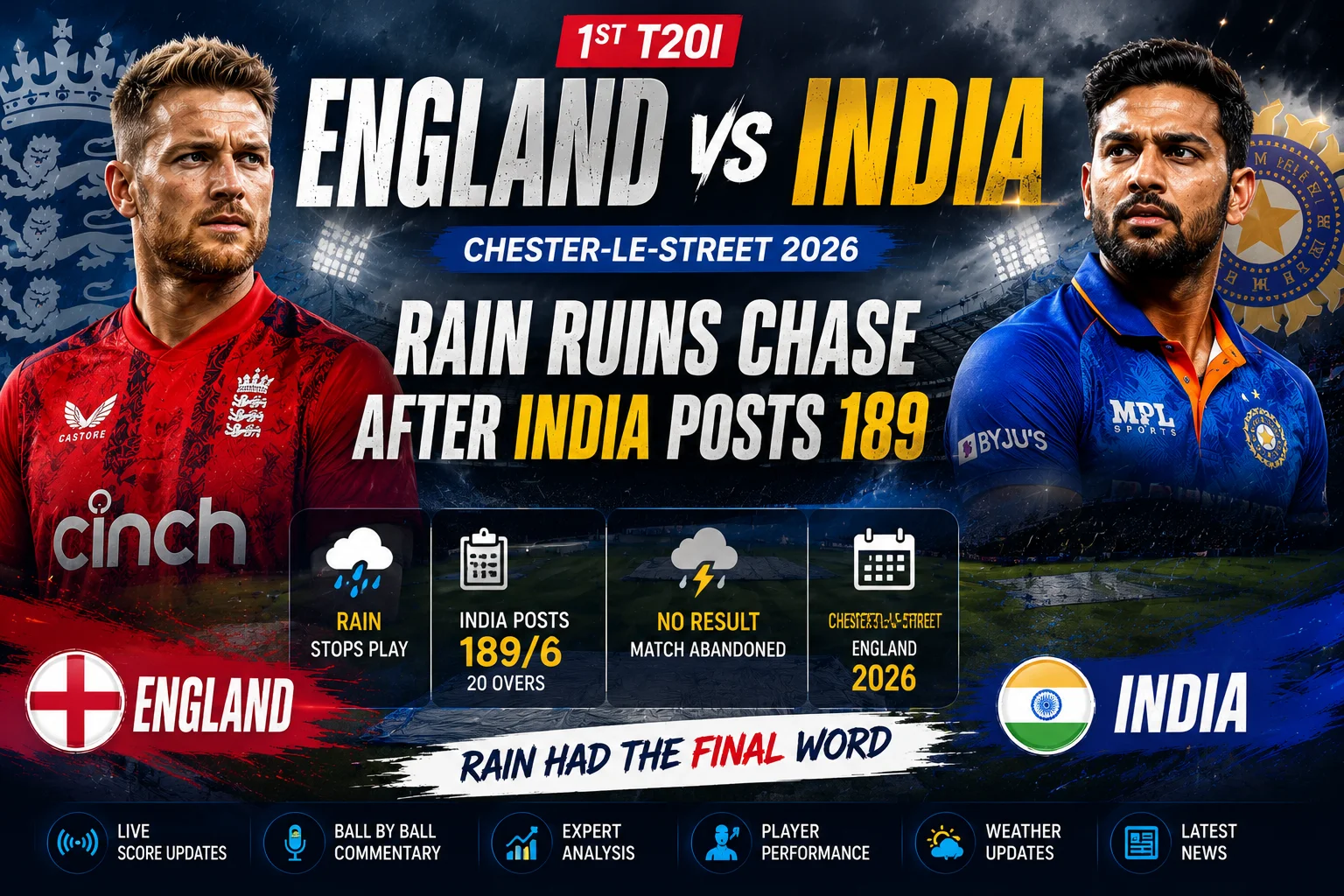
 England vs India1st T20I Chester-le-Street 2026 Abhishek Sharmas Explosive Fifty Powers India to189 Before Rain Denies England Chase Opportunity Series Opener Abandoned Without Result
MATCH REPORT – RIVERSIDE GROUND, CHESTER-LE-STREET, JULY 1 2026
The Riverside Ground at Chester-le-Street witnessed compelling T20 International cricket on July 1, 2026, before meteorological intervention transformed potential championship encounter into abandoned fixture. India’s explosive batting across opening 20 overs produced 189-run total—representing above-par performance on green, moisture-laden English surfaceyet persistent rainfall prevented England’s chase commencement, ultimately negating both franchises’ competitive intentions stake
The match embodied contrasting narratives that characterize contemporary T20 cricket: India’s institutional recovery following Ireland humiliation, England’s post-Ben-Stokes-retirement uncertainty, and individual brilliance narratives (Abhishek Sharma’s explosive hitting, Shreyas Iyer’s captaincy debut performance) overshadowed by climatic circumstance beyond human control stake casino
India’s Batting Context and Institutional Pressure Framework
India’s tour began amid substantial institutional pressure. The devastating 0-2 series defeat against Ireland—occurring merely days preceding England engagement—created imperative for immediate performance recovery. Shreyas Iyer’s captaincy appointment, replacing Suryakumar Yadav following two T20 World Cup triumphs, generated widespread commentary regarding leadership credentials and selection wisdom. Chester-le-Street’s opening encounter represented opportunity for India’s batting unit to demonstrate that Ireland collapse reflected aberration rather than revealing fundamental franchise fragility stake.com
Early batting difficulties suggested institutional concerns persisted. Sanju Samson’s dismissal (caught backward point, Saqib Mahmood bowling) accompanied Ishan Kishan’s run-out confusion—both occurring within opening two overs—replicated Ireland’s batting vulnerability patterns. India arrived at 6-2 after approximately 2 overs: alarming juncture suggesting that selection freshness hadn’t eliminated top-order fragility stake india
Abhishek Sharma’s Explosive Counterattack T20 Cricket at Maximum Intensity
Abhishek Sharma’s entry transformed India’s batting trajectory. The 25-year-old left-hander, possessing world’s highest T20I batter ranking (despite middling IPL 2026 form), launched blistering assault that restored India’s scoring momentum and psychological confidence.
Sharma’s 59-run innings from 24 deliveries represented T20 cricket at maximum attacking intensity. His 20-ball fifty—fastest fifty by Indian batter in English T20I cricket—demonstrated that international-quality pace bowling couldn’t contain aggressive batting intent when technical proficiency aligned with psychological aggression. The innings featured 6 fours and 4 sixes: boundary markers rather than aerial elevation determining scoring acceleration stake login
Sharma’s batting approach reflected deliberate strategy rather than reckless abandon. His off-side placement—particularly effective against Saqib Mahmood’s opening-over bowling—extracted boundaries through conventional batting technique. His lofted-drive execution, characteristic of contemporary T20 batting, generated momentum-shifting contributions that transformed India from crisis (6-2) toward championship position (99-3 at halfway stage
Sharma’s eventual dismissal—trapped leg-before-wicket via Sam Curran’s slower ball in eighth over—arrived when psychological momentum fundamentally shifted toward India. His departure represented momentary setback rather than institutional collapse; subsequent batting ensured India’s scoring acceleration continued stake crypto betting
Shreyas Iyer’s Captaincy Debut Performance Steadying Influence and Batting Contribution
Shreyas Iyer’s appointment as India’s T20I captain generated substantial commentary regarding selection wisdom. His absence from T20I cricket since December 2023 (nearly 7 months) created questions regarding match rhythm recovery and contemporary T20 format familiarity. Chester-le-Street offered immediate leadership credibility examination.
Iyer’s 68-run innings from 47 deliveries represented composed, anchoring batting performance—distinct from Sharma’s explosive approach yet equally valuable for India’s chase acceleration requirements. His positioning within batting order (fourth position) reflected selection strategy: protecting India’s middle order while permitting top-order aggressive batting without conservative constraint stake bonus
Iyer’s batting demonstrated technical soundness: 6 boundaries and 1 six accumulated through conventional stroke-making rather than aerial dominance. His 38-ball partnership with Sharma (82-run combination) fundamentally altered match trajectory, transforming India from survival-focused batting toward championship-position scoring.
Yet Iyer’s batting tempo—SR of approximately 144—suggested cautious approach compared to Sharma’s explosive 246 SR. This tempo differential reflected either surface difficulty perception or captaincy-influenced conservatism. Regardless, Iyer’s contribution provided crucial middle-order stability permitting subsequent batters’ aggressive implementation.
Shivam Dube’s Death-Over Acceleration and Tournament-Defining Role
Shivam Dube’s 42-run unbeaten innings from 21 deliveries transformed India’s final-overs scoring. His 200+ strike rate (particularly remarkable given middle-over periods where batters accumulated 25-run powerplay) demonstrated that Chester-le-Street’s surface permitted aggressive acceleration when bowling deteriorated toward final overs.
Dube’s batting featured clear attacking intent: multiple sixes over mid-wicket and square-leg suggested deliberate targeting of specific bowling areas. His final-overs contribution—accumulating 54 runs across final five overs (with Sharma present initially, then subsequent batters)—established championship-level batting that England’s bowling couldn’t contain. stake cricket
England’s Bowling Performance: Mahmood Redemption and Attack Limitations
Saqib Mahmood’s return to international cricket (after extended absence) produced respectable 3-33 bowling performance. His early-overs accuracy (particularly opening spell generating Samson dismissal) suggested that England’s bowling selection remained strategically sound despite personnel changes Jofra Archer resting post-Test cricket, Jamie Overton injured).
Yet Mahmood’s subsequent bowling following Sharma’s introduction conceded boundaries despite disciplined line bowling. His inability to consistently restrict Sharma’s scoring reflected both batting quality and bowling exhaustion 15+ overs of intensity creating accumulated fatigue).
England’s spin bowling Adil Rashid, Liam Dawson demonstrated characteristic limitations: Chester-le-Street’s moisture-laden surface provided minimal turn assistance; both spinners struggled maintaining dot-ball consistency while containing aggressive batting
Luke Wood’s opening-over performance (5-run concession from 2 deliveries) established baseline batting dominance that persisted throughout innings. Wood’s pace-dependent strategy—relying on atmospheric movement rather than mechanical precision—proved less effective than anticipated on English surface stake withdrawal
Match Context Rain’s Intervention and Series Implications
Persistent rainfall prevented England’s chase commencement. The abandonment announced at 20:15 local time (approximately 45 minutes before cut-off) despite initial weather optimism—frustrated both franchises’ competitive intentions while establishing series-level context.
The “No Result” status prevented either franchise from accumulating points: standard T20I series cricket allocates points only for completed matches. This abandonment left series equilibrium undetermined, placing magnified pressure on subsequent Manchester encounter (July 4) where institutional momentum becomes premium currency
For India, the abandoned match prevented potential series humiliation (chasing 189 represents realistic but challenging proposition); for England, abandonment negated opportunity to establish early series advantage through successful chase.stake app india
Institutional Narratives Established Through Chester-le-Street Performance
India’s Narrative:
India demonstrated sufficient batting quality to construct competitive totals on English surfaces. Sharma’s explosive hitting, Iyer’s composed accumulation, and Dube’s death-over acceleration suggested that Ireland’s failure reflected temporary institutional lapse rather than comprehensive batting deterioration. Yet the 6-2 early-overs collapse indicated vulnerability persisting—concerning indicator for subsequent Manchester encounter against improved England bowling.
England’s Narrative
England’s bowling unit—featuring returning players, post-Test fatigue, and captaincy transition—displayed characteristic quality limitations. Mahmood’s opening-over success couldn’t mask bowling unit’s inability to contain aggressive batting. The abandoned match prevented assessment of England’s batting—particularly critical examination of whether Harry Brook’s captaincy debut would function under chase pressure. stake ipl betting
Series Trajectory Implications
Chester-le-Street’s abandonment established that England vs India series would develop through Manchester, Nottingham, Bristol, and Southampton encounters without first-match momentum advantage. Both franchises proceeding with identical psychological positioning: no established series lead, no institutional momentum, each match representing fresh engagement stake ipl betting
DETAILED MATCH STATISTICS ANALYSIS
India’s Batting Breakdown
-
Sanju Samson: 5 (2 balls) – caught backward point, Mahmood
-
Abhishek Sharma: 59 (24 balls, 6×4, 4×6) – lbw Curran
-
Ishan Kishan: Run out (Tajinder Dhillon mix-up)
-
Shreyas Iyer: 68 (47 balls, 6×4, 1×6) – lbw Mahmood
-
Tilak Varma: 13 – caught off full toss
-
Shivam Dube: 42* (21 balls, 2×6)
-
Axar Patel: 1* (final delivery)
England’s Bowling Performance
-
Luke Wood: 2 overs, 5 runs, 1 wicket (Kishan run out)
-
Saqib Mahmood: 4 overs, 33 runs, 3 wickets (Samson, Iyer, 1 more)
-
Adil Rashid: 4 overs, controlled economy
-
Liam Dawson: Limited effectiveness on moisture-laden surface
-
Sam Curran: 1 wicket (Sharma lbw) stake vs 1xbet
Match Highlights
-
Fastest Indian fifty in English T20I: Abhishek Sharma (20 balls)
-
Saqib Mahmood’s successful comeback: 3/33
-
India’s recovery from 6/2 collapse
-
Final five overs productivity: 54 runs
stakesofficial.com